| Camping on the Oaxaca Coast With Children: Mazunte & Zipolite - Alternative Lives Ten hours from San Cristóbal, five nights on the Oaxaca coast with two children. Riscalillo, a Zipolite orchard site, what we paid and what ... |
Field notes · outside the usual routes
Camping on the Oaxaca coast with two children
San Cristóbal de las Casas → Mazunte, Oaxaca · August 2026
In August 2026 I drove with my two children and two friends to Mazunte, on the Oaxaca coast, looking for golden-sand beaches and bays calm enough to snorkel. Counting breaks, it was a ten-hour drive — and that was leaving early on a Sunday morning to stay ahead of the city traffic. Driving ten hours to sleep in a tent in lowland heat with two children does not sound like a rest. It turned out to be the most relaxed I have been in years.
If you live in, or are visiting, a non-coastal town, most of Mexico is a long way from a beach — even from Oaxaca City to an Oaxacan beach you are probably driving more than three hours. In our case the nearest coastline is the Chiapas coast, a little over three hours away, and it is not the answer it looks like on the map: black sand, and heavy, turbulent open-Pacific water. With two children who are not strong swimmers, I don’t treat it as swimming water. The calm golden bays start further up, in Oaxaca — and that is what the ten hours buys.
The drive: San Cristóbal to Mazunte
I must admit I find long-distance drives in Mexico somewhat intimidating. I don’t drive long distances often, and some of the route runs through fairly isolated, remote country, even though long stretches of it are toll road. My main concern is a mechanical problem leaving us stranded somewhere unfamiliar at best, and possibly unsafe. Travelling with friends helps more than anything — safety in numbers is real, and so is knowing there are more minds in the car to figure out a solution if one is needed.
I also got mentally prepared by thinking about a friend who regularly drives auctioned cars down from the USA to Guatemala. My 600 km would be covered before he had cracked open the first Red Bull of one of his 3,000 km trips. And I drive a Toyota — twenty-five years old but gold. Not in colour; ostentatious is not me. Mechanically, it has not let me down yet.
One thing I learnt on the return trip, worth knowing before you need it: 088 is the Guardia Nacional’s free national attention line, answered around the clock — one of the official numbers to call if you hit trouble on a federal highway.
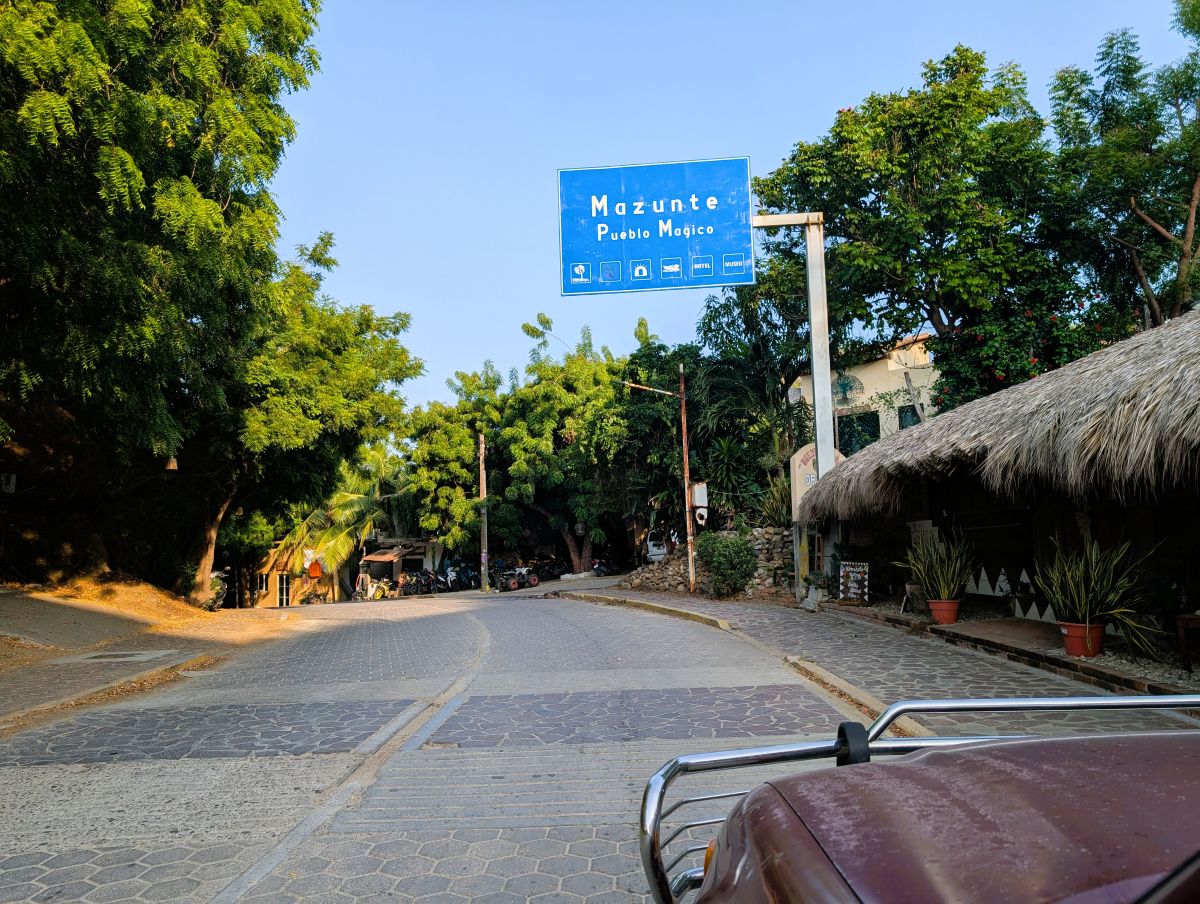
Grabbing a roadside breakfast en route is not normally something worth writing down, but in Mexico it can be. Outside an Oxxo there was a typical roadside food stand — a small table, an umbrella against the sun, four or five plastic stools. Two hours down from the mountains San Cristóbal sits in, it was our first taste of lowland heat in a long while, and the first time I had ever come across tamales with prawns. They cost MX$15 each (August 2026) and were delicious. Even early on a Sunday morning, there had been no need to plan for food.
A taste of the sea, eight hours before the beach.
The first night: Playa Riscalillo
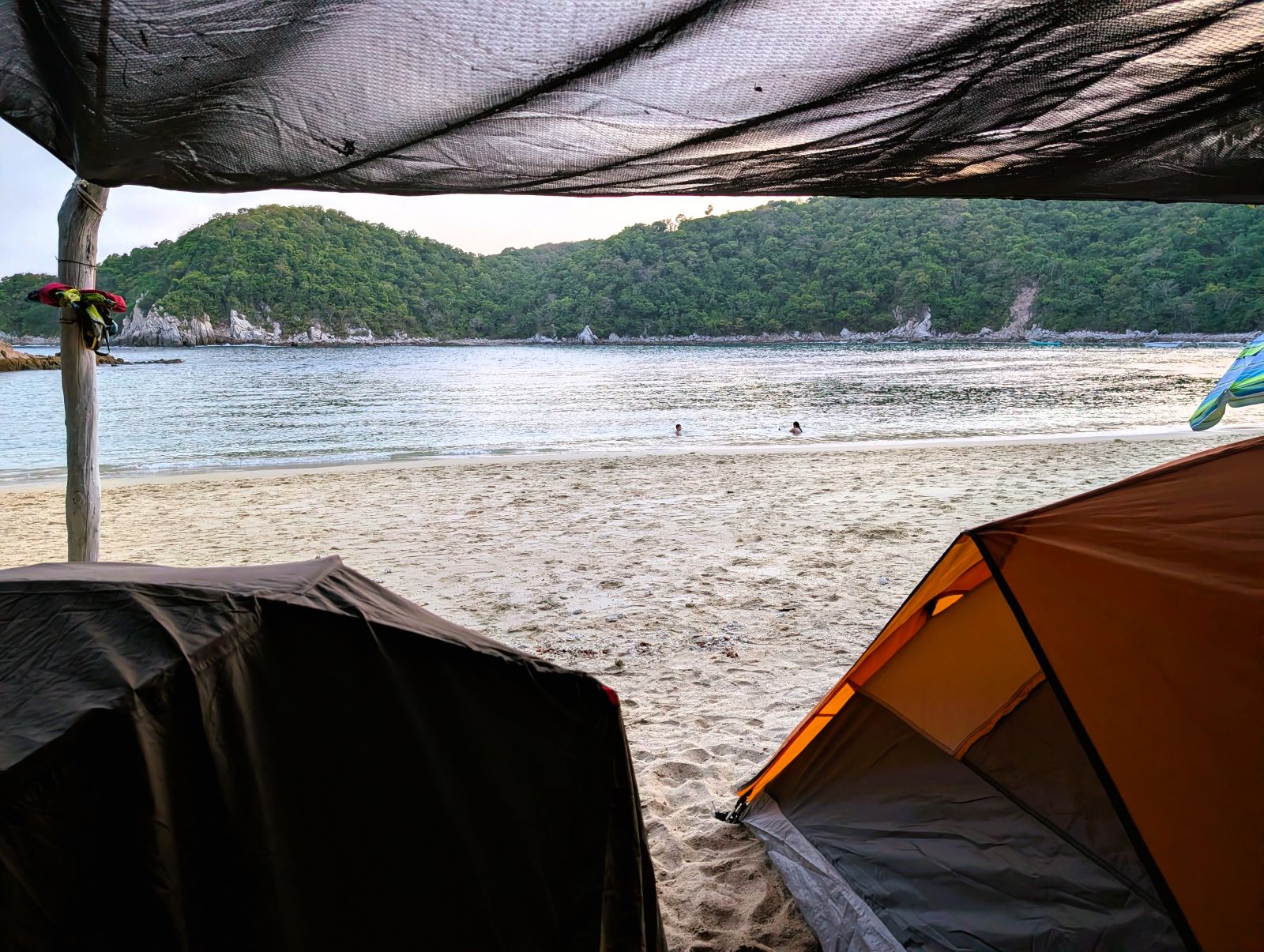
The first night we camped extemporaneously in a small bay called Playa Riscalillo. It was paradise: crystal-clear water, golden sand, and in the evening and early morning, nobody else there at all. We paid the owner of the small piece of land at the end of the beach, and of the small café where I parked, MX$200 per adult to camp under the shade of the dense forest growth — the children weren’t charged (August 2026). He told us the tide would come to within fifty centimetres of the tents, which seemed like an overly precise calculation, but we went with it. The tide came in to where he said it would, and no further.
The bay is a coral reef, with manta rays, schools of fish and turtles. We loved every moment: the snorkelling, and then sitting on the sand in front of the tent at night with the gentle ebb and flow of the water and the Milky Way overhead. As the sun set, the beach filled with hermit crabs, every one carrying a different shell. It was the perfect evening.
Was it too hot in the tent? Being so close to the sea seemed to make the difference — by morning it was almost cool. It seemed to help with the mosquitoes too; there really were not many. One night’s evidence, so take it as that — but it was certainly a relief compared with an earlier trip, when we camped a couple of hundred metres back from the sea, near standing water, and had a much worse time of both.
Why we moved: an orchard campsite in Zipolite
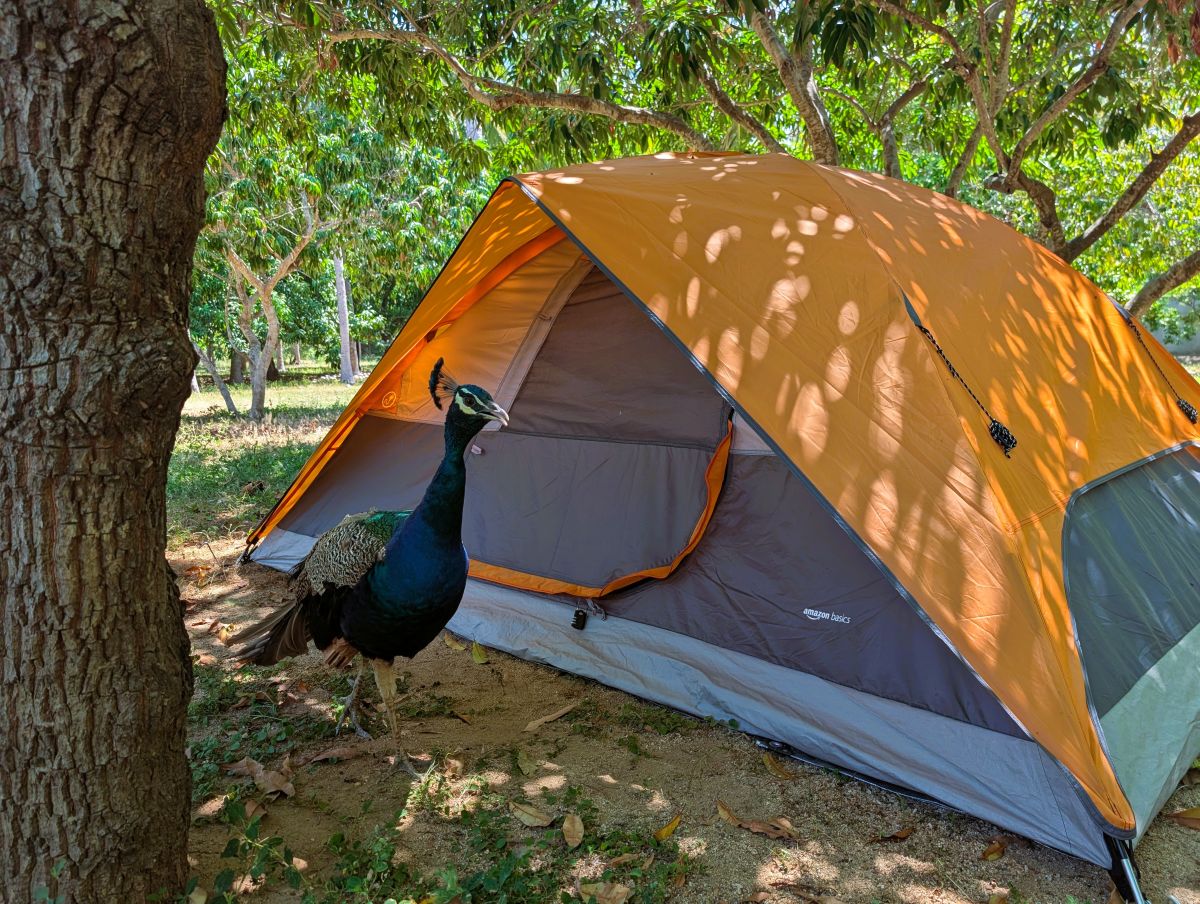
The next day we moved to an orchard camping-and-caravan site in Zipolite. I had found it on Google Maps and contacted the owners beforehand — and, like every site I vetted, they told me there was space and no need to reserve. I chose it mainly because it has a swimming pool, because I knew there would be four or five hours in the middle of each day too hot for the children to be out in. It turned out to be one of the better decisions of the trip.
We were surrounded by fruit trees, with plenty of space, shade, and an electricity outlet close to the tent. Our nearest neighbour was a good fifteen metres away, and I really appreciated that — privacy, and a noise buffer at night. Along the beachfront at Zipolite itself, people were camping with their tents pitched back to back. That is not something I would enjoy.
The orchard charged MX$150 per adult and MX$100 per child under twelve (August 2026). Which brings me to the other thing worth knowing about money on this coast: no two sites work the price out the same way. Riscalillo charged by the adult and didn’t count the children. The orchard counted all of us. Friends camping over in Mazunte paid by the tent, regardless of how many people were inside it. Same family, same coast, same week — anywhere between MX$200 and MX$400 a night, depending entirely on whose arithmetic we were on. You can definitely save a couple of hundred pesos a day by choosing on price. For me the extra was usually worth it — a pool for the hours we couldn’t be on the beach, and space between us and the next tent.
Managing the heat with two children
I had been apprehensive about camping in the heat, especially for the children. What we settled into was a rhythm: the beach in the early morning and the evening, and the middle of the day — roughly eleven until three, which in August was too hot for us to be out on the sand — in the shade and the pool. The children spent the worst hours of the day in shaded water.
The nights sorted themselves out. The first night had already taught us that a tent close to the sea sleeps cooler, and at the orchard the shade did the same work.
Twenty-eight degrees at 7am was the new norm.
Food and drink on the coast
Beer and coconut water are far more ubiquitous on the coast than in other parts of Mexico. Away from the beach itself, which is more touristy, the comedores are full of local people eating quesadillas and working arduously to finish a beer before it goes warm. The builders working on our campsite had beer on a plastic table every day after work.
Anyone who lives by the side of a road with a coconut tree in the yard is selling coconuts — MX$50, or MX$60 if you want one that has been chilled in the fridge (August 2026). Make sure you have a machete or a small axe with you, and you can open the coconut up after drinking the water. Since we were camped surrounded by coconut palms, I spent at least twenty minutes a day refining my dexterity with the machete.
Tortillas. In San Cristóbal we eat handmade corn tortillas with almost every meal, and camping is where they prove themselves: the perfect carbohydrate. They last a couple of days even in the heat, they need no cooking, and you can scoop food straight out of the pan into a large reheated tortilla. Even NASA flies them: the Mexican astronaut Rodolfo Neri Vela asked for tortillas on a shuttle mission in 1985, his crewmates noticed they made no crumbs in weightlessness, and they have been standard fare in orbit ever since. The one surprise in Oaxaca was that corn tortillas took more work to get hold of: we had to walk to a comedor and ask — most will sell you a stack — instead of the handmade tortillerías that sit on every few corners at home.
I also didn’t eat any seafood all week, which seems like madness on this coast. You can buy straight from the fishermen in Puerto Ángel, or eat fish in dozens of nearby restaurants. But honestly, I was content not putting effort into cooked food. The effort went into snorkelling, walking up to the lookout points for the sunsets, and having a very different routine from the one I have at home.
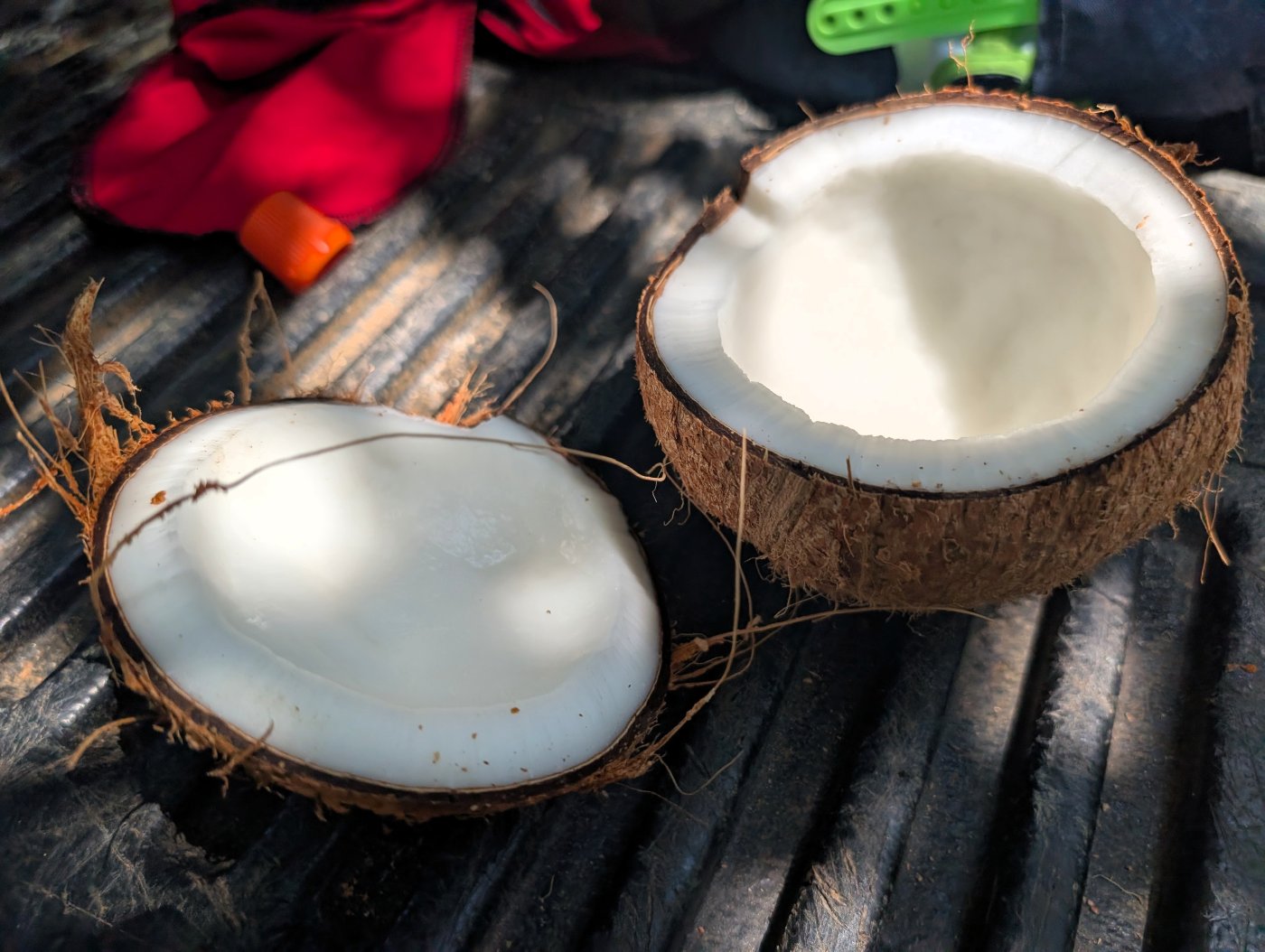
Five days without screens. The only work was cooking — and opening coconuts with a machete.
Five days in
I woke on the Friday morning after five nights of camping. Five days with barely a glance at my phone, no monitors, no TV, no work. The previous evening I had been invited to drink a couple of ice-box-cold beers with a Mexican family travelling in a Mercedes Sprinter, who we had become friends with. The friendship began over food: the abuela had witnessed me cooking an unusually poor meal — my gas canister was running out, so the eggs and beans stayed mushy in the pan — while she cooked quesadillas ten metres away. She came over, sympathetically, with piping-hot ones on a plate, to make sure my children would have food that looked fit for a human. The next morning I shared a papaya with them.
At seven that morning I walked over to the carambola tree with my daughter and we quenched our thirst straight from the branch, with a perfectly ripe star fruit. I was no longer micro-managing the ants that walked into my sandals and occasionally made me feel I was in an acupuncture session; somewhere in the week I had developed a nonchalant reflex for swiping them off. Twenty-eight degrees at 7am, a star fruit in hand — living in God’s kitchen with a broken thermostat had become completely tolerable, even rewarding. I was completely relaxed.
The carambola tree · Zipolite
Breakfast hanging within reach — the carambola (star fruit) tree beside our tent at the orchard site.
One of the fruits I pulled from the tree had a small brown patch along one edge — normal, as a fruit passes from ripe towards overripe. This time I picked at the brown with a fingernail and found a small worm. The disgust hit, then subsided. Instead of throwing the fruit down, I thought of the workmen on the campsite. All week I had watched them pick up fallen mangoes already substantially eaten by wasps, flies and the roaming chickens — roll the fruit over in one hand, find the undamaged side, peel the skin back with their teeth and eat the intact half cleanly before dropping the rest, like vampires homing in on the one good jugular. None of them had missed a day sick; it was always the same four men working. My star fruit had never even touched the ground. I took off the area around the worm hole, forced the image out of my head, ate the fruit, and didn’t get sick. The new, more relaxed me.
By the last days, fruit was doing a lot of our daytime hydration — partly for the taste, and partly because the 20-litre garrafón we bought every three or four days was always warm, and I don’t love drinking warm water out of a plastic bottle. The children still drank plenty of water; but eating fruit, which I eat very little of at home, had become a feel-good routine of its own.
I had purposely not filled the days with trips and excursions. Space to relax was the point — and relaxing, it turns out, is something I needed to practise.
What I’d do again
- Take an ice box. Buying ice at the beer deposits and the Oxxo kept our milk and cheese cold for more than 24 hours at a time.
- Choose the site for shade, water and space. A shaded pool carried us through the four or five unusable midday hours, and fifteen metres to the nearest neighbour changes the night. The caravan-and-camping parks tended to offer far more space than the small beachfront sites.
- Camp close to the sea if you can. One trip’s evidence, but our night by the water was cooler and had fewer mosquitoes than an earlier site further back near standing water. I’d pitch by the sea again.
- Move between the quieter bays. Shifting camp is how we ended up snorkelling a reef with nobody else on the beach — the serene settings are there if you keep moving.
- Don’t over-plan the booking. Every site I contacted in August 2026 had space and told me not to bother reserving. I stopped worrying about it. Your month may differ.
- Bring home mezcal and cheese. The queso on the coast was far creamier than anything we get in San Cristóbal.
- A small luggage lock for the tent zip. A tent is fabric, so it stops nobody determined — but I never felt at risk of being robbed, and the lock bought real peace of mind whenever we walked down to the water.
The general kit — the ten things we always carry, coast or highlands — is its own page: camping in Mexico with two children.
Was it worth the drive?
Ten hours each way is a real price, and I won’t pretend otherwise — the return leg is where I learnt what the 088 number is for, even if I never had to use it. But against that: five nights under trees, a reef with turtles at the end of a beach with nobody on it, new friends with an ice box of cold beer — and the most relaxed I have been in years. We will be going back.
— Luke Burchell
Field notes
If this is the kind of writing you came here for, I send a new field note now and then — occasional, and only when there’s something real to say.


No comments:
Post a Comment
Thank you. Comments are welcome.
ivan